Contact Me
Let's have a  together and answer your questions. together and answer your questions.
Ways to Support My Work
Subscribe to Insight-Live.com. It is about DIY testing, recipe & photo management, glaze chem and managing all the data. Help Me on Social

Login to your account
Chemistry plus physics.
Maintain your recipes, test results, firing schedules, pictures, materials, projects, etc.
Access your data from any connected device. Import desktop Insight data (and of other products).
Group accounts for industry and education. Private accounts for potters.
Get started.

Download for Mac, PC, Linux
Interactive glaze chemistry for the desktop. Free (no longer in development but still maintained, M1 Mac version now available).
Download here or in the Files panel within your Insight-live.com account.
What people have said about Digitalfire- Thanks for sharing so much great information!
- I am a builder / developer / consumer of ceramic tiles. You have a sea of information on your site.
- I must say that your article on geting pink colors from Chrome and Tin had an appealing writing style and was very informative.
- As I read this I am thinking wow, what a great article, so useful and I love the details of the pictures.
- First, let me thank you for creating such a wonderful, informative, and comprehensive site. I know that I will spend many a long hour pouring through your pages.
- I find the educational section of your website informative and it is very generous of you to share your expertise with the the rest of us. Thank you so much for your kind assistance.
- I have been thinking to thank you for the great help your interest in ceramics continues to inspire in my studio.
- Again, thanks for building a website that has been very influential in how I look at ceramics in general, and that has been such a valuable resource to my work as a student, production potter, and chemist.
- All your info on glaze chemistry and material characteristics are very informative and great catalysts for pushing me to take things a bit further. Most appreciated.
- I am very thankful that you are so good at what you do! Thank you for all your hard work!
What people have said about Insight-Live- Thank you so much for all your written out knowledge on materials. I'm the manager of our art school program, where we make our own clay and glazes. Your articles have helped me endlessly.
- I have found your website to be extremely helpful because of your analysis of glaze chemistry and other information too. I have been able to mix all my own glazes and troubleshoot with the information you provide. I want you to know how much you're helping fellow potters all over the country and I truly appreciate your generosity in sharing the information.
- I'll feel sorry for the world when you're no longer around to produce such content.
- Tony, I just love your posts! What a great teacher you are! I appreciate the continued chance to learn from you.
- You have such a brilliant analytical mind, able to find solutions to many ceramic problems. You have accomplished so much in your life, helping us potters understand what we are doing. I cannot thank you enough for your vast ceramic reference library online. I think you are a national treasure.
- I am a longtime fan and user of digitalfire. I have learned so much by reading the information you have published; I’ve always been so grateful to have it to read.
- I am a potter of over ten years and am now in this year paying attention to my glazes and what goes in to them. It's been an awesome journey with plenty of "ah ha" moments and exponentially more "what the..." moments. Regardless of what I'm feeling, digital fire is so far the best resource I've encountered. I’ve been going about glazes all wrong, following recipes and stabbing in the dark hoping to find one that Works for me... well, it’s not working! I’m devoting my time to explore glaze chemistry even more than I have and to do this I am convinced I can not go forward efficiently without a test kiln. THANK YOU for these wonderful resources!
- You have no clue how much this site has inspired and helped me develop my love for ceramics and chemistry.
- I would like to thank you, I have looked through books and books and books, and here you are with so much fantastic information about what to do with the free clay that we can find outside. Even just saying that the clay has to be dry when you put it in water, what an eye opener. It is amazing what you do. I take my hat off to that.
- What you have created is a god send to thousands of potters and me.
| Practical posts like these. No ads or tracking. The first email will provide one-click unsubscribe. Please subscribe inside your insight-live.com account or email me.
Blog
Cone 10R clear glaze made more "clear":
Using frit to source Na2O instead of feldspar
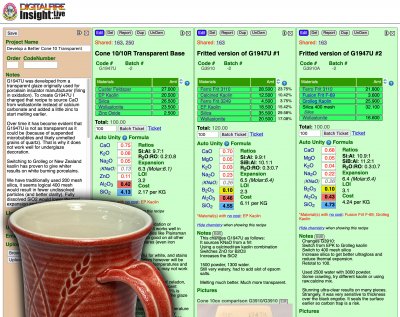
To get a better, more brilliant transparency than G1947U, at cone 10R, I tried sourcing Na2O from a frit. The inside surface on this mug is the result (v2), it is so glossy it looks like a low-fire leaded glaze. This screenshot of side-by-side panels shows the frit-enhanced version(s), G3910 and G3910A. Frit 3110 has a much higher concentration of KNaO than the feldspar, a key to making a brilliant glass. While this increases the COE, the fact that it comes from this frit brings multiple benefits:
-A brings a little B2O3, a better melter than zinc (which volatilizes anyway at cone 10).
-It dissolves more low-expansion glass-forming SiO2 (in v2 I switched to 400 mesh silica to enhance that even more).
-The glaze can then tolerate some low-expansion MgO (introduced by Frit 3249 or its equivalent, Fusion Frit F-69).
More details about this project can be found by clicking/tapping the Insight-live recipe code numbers G1947U, G3910 or G3910A. The red outside glaze is G2571D1.
Context: Ferro Frit 3249, Click here for case-studies.., Frit vs Feldspar in.., GLC
Wednesday 30th September 2026
Same glaze, same stain percentages
Yet two stains give completely different results
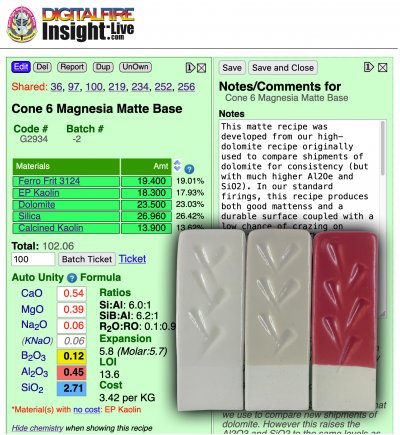
- Left: A cone 6 matte glaze (G2934 with no colorant).
- Middle: 5% Mason 6006 chrome-tin red stain added.
- Right: 5% Mason 6021 encapsulated red stain added.
Why does the red color not develop in the center glaze? This host recipe does not have the needed chemistry to develop the #6006 chrome-tin color (Mason Colors provide glaze unity formula guidelines: 6.7–8.4% CaO and avoiding MgO). This glaze recipe calculates to 9.8% CaO and almost 5% MgO. The MgO is the likely reason the red fails to develop. Yet this glaze produces excellent color with #6021 encapsulated stain. Encapsulated stains are commonly used at high percentages, but not here. Strong red is achieved here at just 5% stain, that is an amazing result.
Context: Mason 6021 Red Stain, G2934, Formulating a Clear Glaze.., Stain 6006, Encapsulated Stain
Wednesday 30th September 2026
Copper glaze bubbles:
More melt fluidity helps - but watch the running!
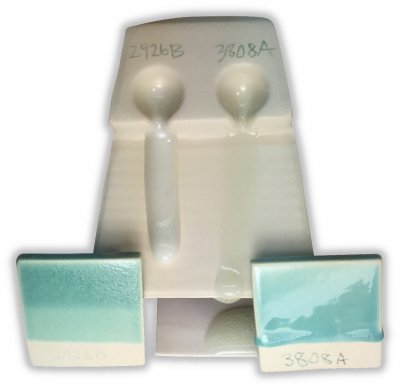
These tiles were fired at cone 6. The melt-flow comparison behind them shows how much more freely the G3808A clear base flows than G2926B. G2926B produces a crystal-clear glass by itself and works well with some colorants. But with 2% added copper carbonate, its melt does not clear the bubbles and heal the surface completely. G3808A has enough melt mobility to produce a smooth surface.
That extra fluidity comes at a price: Notice the glaze running down the right-hand tile. To get this clear, glossy copper color while controlling movement, strategies include thinner application, keeping the glaze farther above the foot, restricting it to more horizontal surfaces or using a tested catcher glaze below it.
Context: G3806C, More copper can produce..
Tuesday 29th September 2026
Alumina-lined crucible frit ingot test:
The first of multiple milestones to making your own frit
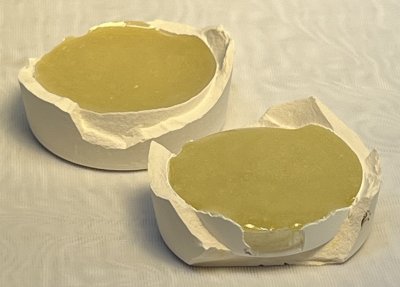
To melt a frit batch, the first challenge is the crucible and release from it. These disposable crucibles were cast from L4404A refractory slip. The front one has an alumina-based liner L3693E. Without the liner, the ingot in the back is inseparable from the crucible wall. But in the other, the alumina has remained as a powder and can be cleaned off the ingot, leaving almost no residue. This test was done at cone 04, so only a tiny amount of Al2O3 is taken into solution in the melt.
Why would a potter consider doing this? Problems with commercial frit availability and consistency are motivating some to investigate making their own. But there are more challenges. Commercial frit manufacturers control melting conditions to produce a homogeneous glass, then crash-cool it to limit crystallization and facilitate grinding. Their furnaces ensure heat distribution throughout the batch (a real challenge in a crucible in a pottery kiln). But some frit compositions are considerably more resistant to grinding; a studio ball mill might not be up to the task. Producers also melt frits at cone 13-20 (a potter frit-firing to cone 10, what a producer smelts to cone 15, risks producing a partially reacted mixture of glass and undissolved solids, rather than the homogeneous frit intended by the formulation). And their furnaces are in no danger of cracking during firing. And they have expertise to formulate and test for low water solubility (yes, glass having an unstable chemistry can dissolve in water). They also have tight control over the particle size of the finished powder. They also have equipment to control dust during crushing and grinding (remember - that the dust is tiny angular glass shards!).
Context: ChatGPT has an opinion.., Richard Bideau makes his..
Monday 28th September 2026
This bird knows how to find and use wild clay:
If she can do it, maybe you can
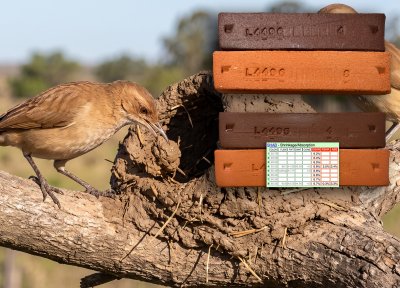
She is likely getting it from nearby. She knows what works: A mix of sand, clay and organic matter. She isn't even the best mud-nester in the bird world. Some species can stick their nests on to walls and cliffs.
If a bird can find and use a native clay, should a potter or even hobbyist be intimidated by the prospect of doing the same? She doesn't overthink it; she likely just samples different spots and uses the one that works the best. The clay appears to be a typical terracotta; if her nest were fired, it could well come out like these overlaid SHAB test bars (the two types, a sandy and smooth, were fired at cone 4 and 04).
Finding a native clay for pottery can begin just as simply: collect small samples from different spots, see how each one works, and watch how it dries. Then take the step the bird has no reason to take—fire test bars. These show how I compare drying shrinkage, firing shrinkage and fired absorption. A nest proves that mud can be built with. Test bars help determine what that mud can become in a kiln.
Context: Evaluating a clay's suitability..
Sunday 27th September 2026
Two practical ways to test incoming bentonite shipments:
Both dilute its extreme plasticity with a non-plastic material

If you manufacture clay bodies, bentonite deserves more incoming-material testing than its small percentage in recipes might suggest. Because of its highly concentrated nature, bodies are disproportionately affected by variations in its plasticity, soluble salts, particulate contamination, fired color (and another property we will see in a moment). Consider why it is wise to accumulate test data to establish a reliable baseline against which to compare every shipment.
The top two bars are a Wyoming bentonite fired to cone 8 and 2 oxidation. But they are not made from the raw bentonite alone. The test mix is 15% raw bentonite and 85% of the same material after calcining. The calcined portion acts as a non-plastic filler, reducing the extreme plasticity enough that SHAB test bars can be formed and dried reliably. They provide a revealing picture of the fired properties as a pure material.
The bottom two bars use a different approach: A standardized dilution of 15% bentonite mixed with 85% silica. These make evident its effect on the fired characteristics of a pure white, refractory and non-plastic material. The loss of whiteness is obvious, and the lack of fired specks notable. But another thing still reinforces viewing this bentonite as a “controlled impurity” addition: These bars should be much more refractory, but they are porcelain-like, albeit with high porosity, the bentonite itself is acting as a body flux.
Context: HPM-20 Volclay Bentonite, Bentonite, Soluble salts as a.., A super-fine super-plastic wild.., This bentonite fires almost..
Saturday 26th September 2026
A YOLO glaze recipe gets a reprieve
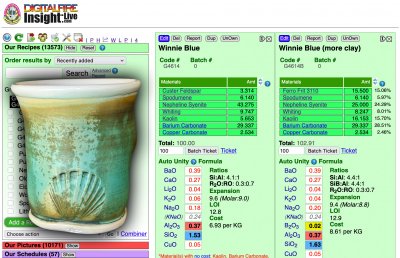
This recipe is pretty far out on the edge for a glaze rescue. But the potter loves the appearance, so it is still worth preserving for decorative or non-food-contact use. Of course, one must go in with eyes open about its application, fit and durability issues. Consider the obvious red flags:
But this glaze has one thing the potter values: it appearance (see image). So rather than discard it, we reworked the material sourcing while keeping the oxide chemistry very similar. I reduced the nepheline syenite substantially and introduced Ferro Frit 3110 to supply much of the KNaO without bringing much Al2O3 with it. That enabled the kaolin percentage to almost triple, from 5.7% to 16.2%, while calculated Al2O3 stayed at 0.37. The result should be a much more practical slurry while giving the glaze a reasonable chance of retaining the character that made it worth rescuing in the first place.
However, the new recipe still has 29% barium carbonate and a calculated expansion of 9.4, so this is not a “fixed glaze.” It is a more usable version of an intentionally problematic glaze.
Context: Barium Carbonate, GLR
Wednesday 23rd September 2026
When a clay body loses plasticity:
Let the test data decide
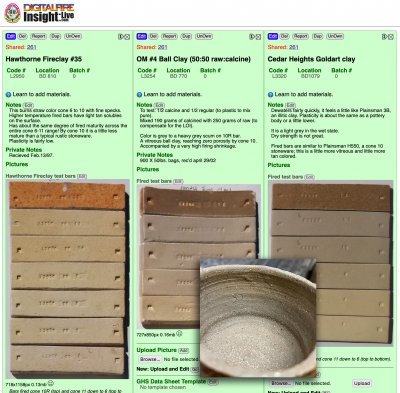
A potter uses a grogged body that contains a mix of three clays (with small amounts of feldspar, bentonite and silica, likely for tuning fired maturity, plasticity and COE). It fires to a dense light tan at cone 10 (as shown). Although his pugmill does not have a vacuum chamber, until now the body has worked well. For whatever reason, it now has become insufficiently plastic, so some "recipe engineering" seems like the best option.
The obvious response is adding more bentonite. But bentonite works best when the mixing system can thoroughly disperse it, and this pugmill likely cannot do that reliably, even with the 3.5% already in the recipe. Fortunately, physical testing I did years ago on Hawthorn Fireclay, Goldart and OM#4 ball clay provides data that enables comparing their plasticity and fired maturity. Armed with that, we can change the proportions of these clays in the recipe (see the full report by clicking/tapping their code numbers: L2950, L3320, L3254).
The three fire to a similar color, which simplifies things. So here is my test #1: Increase the ball clay by 20% at the expense of Hawthorn, the least plastic of the three. Drop the bentonite. The body will fire more vitreous, so compensate by trading 5% of the feldspar for 5% more ball clay. An SHAB test comparing the original and the new mix will give direction to test #2. Since ball clay is so high in quartz, that test could trade all of the silica for Hawthorn fireclay (glazes will likely fit without it, and the body will be even more plastic).
Context: Maturity, Plasticity, Material Sense
Wednesday 23rd September 2026
Ceramics is impossible!
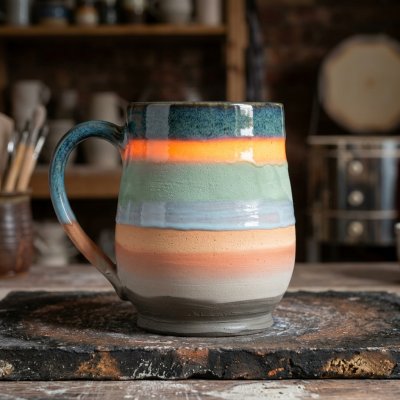
This mug blends the stages of ceramic production into one and builds appreciation for how magical the ceramic process is. That can help set realistic expectations for production. Consider:
- How can a minority of microscopic clay particles, through their surface charges and enormous collective surface area, bind a mass of other nonplastic mineral particles into something that can be shaped? Using just water as the glue?
- How is it even possible that a handle can become rigid during drying while the mug body continues to shrink and dry, yet no crack occurs?
- How can a clay-containing glaze powder, which must shrink on drying, stick to a smooth bisque surface and not crack off?
- Temperature gradients are inevitable, meaning different parts of the mug are not passing through the same stages of quartz inversion, yet it does not dunt.
- How can a clay body soften as if it vitrifies in the kiln yet still stand up and hold its shape?
- How can two ceramic powders, neither of which melt, melt if they are mixed together?
- How can a glaze melt enough to produce a brilliant gloss and yet not run down off the ware?
- How can micro-bubbles in a glaze on a vertical surface find their way to the surface, break and yet the surface heals behind them?
These things seem impossible or improbable, yet ceramics does them routinely. That should encourage us to understand the mechanisms, measure the variables that matter and build enough margin into our processes that normal variation does not push them over the edge into failure.
Context: Tipping point
Wednesday 23rd September 2026
A crackle glaze is crawling
An excellent case for a DIY brushing glaze
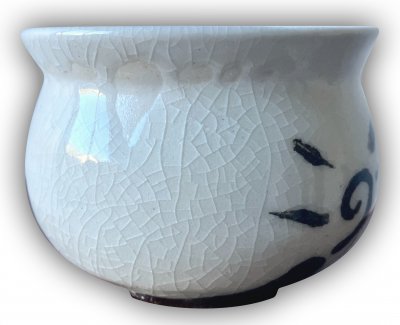
A potter uses a 70% potash feldspar, 20% whiting, 10% kaolin glaze for a crackle cover over iron oxide brush strokes. While it fires crystal clear, it has a problem: it crawls. While it can be flocculated with Epsom salts, and the application and dry adherence are fairly good; this crawling problem is occurring. By mixing it as a DIY brushing glaze we can fix three of its problems without changing the recipe: Its tendency to go on too thick, the entrained bubbles in the clear glass and the crawling. Don’t dismiss this idea immediately. This is a special-purpose surface and brushing can be done more quickly than you might think. Careful control of thickness is possible and the CMC gum in the glaze will make it adhere much better (eliminating the crawling). The consistently thinner coverage will also make it possible to produce crystal clarity with fewer micro-bubbles in the glass. A hybrid approach is also possible: Pour glazing the inside and brushing the outside.
Context: A glaze slurry needs.., Add CMC gum to.., Brushing Glaze
Monday 21st September 2026
|